
Construction & Building Material Blog
2026 Best EPS Foam Board Types for Global Buyers?
Table of Contents
- EPS Foam Board Fundamentals and Core Material Properties
- Major EPS Foam Board Types for Different Global Applications
- How to Compare Density, Thickness, Strength, and Thermal Performance
- International Standards, Certifications, and Market Requirements
- Selection Guide for Buyers, Suppliers, and Project Conditions
- FAQS
- Conclusion
- Related Posts
Choosing the right EPS Foam Board in 2026 requires more than comparing prices. Global buyers must evaluate density, thermal performance, dimensional stability, surface finish, and documented compliance. A board that performs well in a dry warehouse may respond differently in humid coastal conditions. That difference matters.
This guide introduces major EPS foam board types for insulation, packaging, construction, and decorative applications. It examines standard white EPS, graphite-enhanced EPS, molded boards, and cut boards. Each option has practical strengths. Standard EPS usually offers a familiar balance between cost and insulation. Graphite EPS can improve thermal resistance, but buyers should verify testing data and installation requirements. Molded boards may provide cleaner edges, while cut boards can suit larger custom dimensions.
Specifications deserve careful attention. Check density, water absorption, compressive strength, flame performance, and thermal conductivity. Also review board thickness, tolerances, packaging, and container loading. A 1,200-by-600-millimeter panel can be easy to handle, but damaged corners may reduce installation efficiency. Reliable suppliers should provide current technical data sheets, test reports, factory details, and traceable batch information.
Local standards still control final acceptance. Do not assume one certificate works in every market. That assumption can become expensive. Buyers should request samples before placing large orders and inspect surface quality, odor, warping, and cutting accuracy. Some recommendations may change after testing real products in real climates. That is a limitation worth admitting. Product selection should remain evidence-based, application-specific, and open to revision.
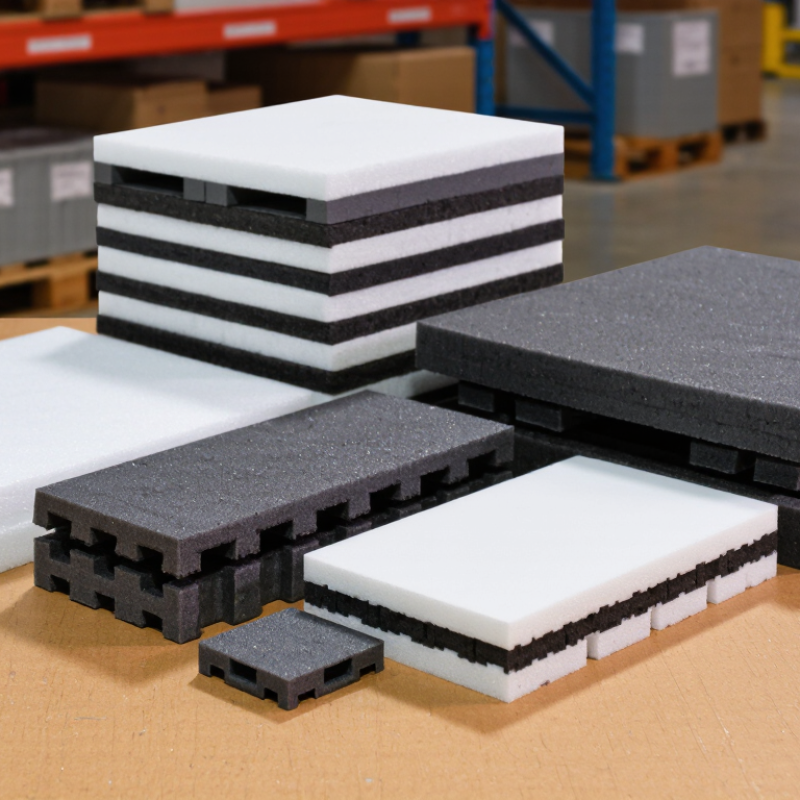
EPS Foam Board Fundamentals and Core Material Properties
2026 Best EPS Foam Board Types for Global Buyers?
EUMEPS technical guidance commonly reports EPS densities of 15–30 kg/m³ and thermal conductivity near 0.030–0.040 W/m·K. Lower-density boards are lighter, but they usually offer less compressive strength.
ASTM C578-23 classifies EPS products by density, strength, and thermal resistance. Typical compressive strengths range from about 70 to 250 kPa, depending on grade.
These figures are not interchangeable. Testing temperature and conditioning can change results.
Standard white EPS suits walls, roofs, packaging, and general insulation. Graphite-enhanced EPS may provide lower thermal conductivity at similar thickness. High-density grades fit floors, foundations, and areas exposed to repeated loading.
Fire performance deserves careful checking. EPS can soften under high heat, so buyers should verify the complete wall or roof assembly, not only the board. EN 13501-1 classification and local code requirements remain important.
Moisture also matters. Ask for water absorption, dimensional stability, density tolerance, and lambda values at a stated mean temperature.
The IEA Buildings 2023 report links buildings with roughly 30% of global final energy demand, making continuous insulation increasingly valuable.
The awkward point is simple: a cheaper board may cost more after shrinkage, crushing, or installation errors.
Major EPS Foam Board Types for Different Global Applications
2026 Best EPS Foam Board Types for Global Buyers?
Major EPS Foam Board Types for Different Global Applications
Expanded polystyrene foam boards vary by structure, density, and surface treatment. Standard molded-bead EPS boards suit wall insulation, roof systems, and packaging inserts. Their low weight reduces handling costs during international shipping. However, buyers should check compressive strength before specifying them for floors or heavy panels.
High-density EPS boards perform better beneath concrete slabs, road foundations, and industrial flooring. They resist greater loads but usually cost more and may require careful cutting. Graphite-enhanced EPS offers improved thermal performance in thinner wall assemblies. This can help projects with limited cavity space, especially in colder regions. It still needs compatible installation details and verified thermal data.
Laminated EPS boards include facing layers for specific construction or packaging needs. They can improve handling, surface protection, or moisture control, depending on the facing material. Fire-retardant grades may reduce flame spread under defined test conditions, but they are not fireproof. Always request test reports for the destination market. Requirements differ across regions.
Density alone is not enough. A higher number may not solve moisture, movement, or installation problems. Buyers should compare thermal conductivity, dimensional stability, water absorption, and declared tolerances. Small details matter. Board edges, pallet protection, and container loading can affect arrival quality. A practical mistake is choosing the cheapest grade first. Long-term performance often depends more on application fit than initial price.
How to Compare Density, Thickness, Strength, and Thermal Performance
2026 Best EPS Foam Board Types for Global Buyers?
When comparing EPS foam boards, start with density, but do not treat it as the whole answer. Density is usually listed in kilograms per cubic metre. Higher density often improves compressive strength and handling. However, it can also increase cost and weight. A 20 kg/m³ board may suit light insulation, while a 30 kg/m³ grade may perform better under regular loading. The correct choice depends on the assembly, not a catalogue number.
Thickness directly affects heat resistance. A thicker board generally reduces heat transfer, provided joints are tight and installation is consistent. Check the declared thermal conductivity, usually shown as lambda or W/m·K. Lower values indicate better insulation. Compare results tested under similar conditions. Otherwise, the numbers may look precise but remain difficult to trust. Humidity, temperature, and ageing can influence actual performance.
Strength needs a separate review. Ask for compressive strength at a stated deformation level, not only a vague “high strength” claim. Check bending resistance when boards will be moved, cut, or installed overhead. Request technical data, test methods, production tolerances, and batch records from the supplier. Small thickness variations can create visible gaps. I would also inspect sample edges and corners before placing a large order. A perfect laboratory result may not survive careless storage, uneven substrates, or repeated handling. That part is easy to underestimate.
2026 Best EPS Foam Board Types for Global Buyers
Comparing density, thickness, compressive strength, and thermal performance
Generic EPS reference classes show the usual trade-off: higher-density boards generally provide greater compressive strength and slightly lower thermal conductivity. Thermal resistance depends on thickness and can be estimated as R = thickness ÷ thermal conductivity. For example, a 100 mm board with a thermal conductivity of 0.035 W/m·K provides approximately R 2.86 m²·K/W. Actual values may vary by manufacturer, test method, moisture condition, and national standard.
International Standards, Certifications, and Market Requirements
2026 Best EPS Foam Board Types for Global Buyers?
For global buyers, EPS foam board selection starts with the destination market. Standard white EPS suits general wall, roof, and floor insulation. Graphite-enhanced EPS can provide stronger thermal performance at similar thickness. Fire-retardant grades may support stricter building designs, but their classification must be verified, not assumed.
EN 13163 covers factory-made expanded polystyrene products in European markets. Buyers should check declared thermal conductivity, compressive stress, water absorption, dimensional stability, and reaction-to-fire performance. EN 13501-1 may classify fire behavior, while ASTM C578 applies to many North American insulation applications. These standards are not interchangeable. A certificate from one region may not satisfy another authority.
The 2023 Global Status Report for Buildings and Construction, published by UNEP and GlobalABC, reported that buildings represented about 34% of global energy demand and 37% of energy-related and process emissions in 2022. That pressure is increasing demand for tested insulation systems. Still, thermal values alone can mislead. Installation quality, joint gaps, moisture exposure, and aging affect real performance. Very practical details matter: a board with damaged edges can create cold bridges across a wall.
For export projects, request test reports, factory production-control records, product declarations, and an ISO 14025-based environmental product declaration when available. Also review local fire, chemical, recycling, and labeling requirements. I have seen specifications fail because paperwork described the product, but not the complete installed system. That remains an uncomfortable lesson.
Selection Guide for Buyers, Suppliers, and Project Conditions
2026 Best EPS Foam Board Types for Global Buyers?
Selection Guide for Buyers, Suppliers, and Project Conditions
Choosing an EPS foam board starts with the project, not the catalog. Standard white EPS suits general wall insulation, packaging, and protected floor applications. Graphite-enhanced EPS can provide improved thermal performance at similar thicknesses. It may help when wall space is limited. High-density boards are better for floor systems, foundations, and areas exposed to repeated loading. A higher density is not automatically better.
I have seen buyers compare only price and thickness. That approach often creates problems later. Check compressive strength, thermal conductivity, water absorption, dimensional stability, and bead structure. Ask suppliers for recent test reports, production tolerances, safety data, and sample boards. A sample should be cut, weighed, and inspected for gaps or weak edges. Small defects matter during installation.
Project conditions should guide the final specification. In humid climates, protect boards from prolonged water exposure and confirm compatible adhesives. For external walls, review the complete insulation system, including mesh, render, fixings, and fire performance. Requirements differ between countries and building types. Suppliers should confirm factory quality controls and packing methods for long-distance shipping. Buyers should also verify local standards with qualified professionals. I still allow a small margin for cutting waste, because drawings rarely match every site condition.
2026 Best EPS Foam Board Types for Global Buyers? - Selection Guide for Buyers, Suppliers, and Project Conditions
Comparative selection table for common expanded polystyrene board grades. Values are typical indicative ranges and should be confirmed against the supplier’s certified technical data and the applicable local building code.
| EPS Board Type | Typical Density (kg/m³) |
Thermal Conductivity λD (W/m·K) |
Compressive Strength at 10% Strain (kPa) |
Typical Water Absorption (Volume %) |
Dimensional Stability (Approx.) |
Main Advantages | Best-Fit Applications | Project Conditions to Check |
|---|---|---|---|---|---|---|---|---|
| Standard White EPS Board | 15–25 | 0.035–0.040 | 70–150 | Approximately 2–4% after short-term immersion, depending on grade and test method | Typically ≤0.5% after conditioning | Low cost, lightweight, easy to cut, widely available, suitable for general insulation work | External wall insulation, cavity walls, pitched roofs, floors with moderate loads, packaging and general thermal protection | Confirm wind-load fixing, fire classification, moisture exposure, surface protection and required thickness |
| Graphite-Enhanced EPS Board | 15–25 | 0.030–0.033 | 70–150 | Approximately 2–4%, subject to product design and testing | Typically ≤0.5% after conditioning | Lower thermal conductivity than conventional white EPS; can achieve a target U-value with less thickness | High-performance external wall systems, façade retrofits, areas with limited insulation depth and low-energy buildings | Protect from prolonged direct sunlight during storage and installation; verify compatibility with render, adhesive and façade system |
| Medium-Density EPS Structural Board | 25–35 | 0.033–0.038 | 150–250 | Approximately 1.5–3% | Typically ≤0.5% after conditioning | Higher load capacity than standard EPS while remaining lightweight and workable | Floor insulation, commercial roof build-ups, basement walls, lightly loaded slabs and insulated panels | Calculate permanent and live loads, long-term creep, joint detailing, compressive stress and bearing conditions |
| High-Density EPS Board | 30–45 | 0.033–0.038 | 200–500 | Approximately 1–3% | Typically ≤0.5% after conditioning | Higher compressive resistance, good thickness stability and suitability for demanding load conditions | Inverted or protected roof systems, heavy-duty floors, parking areas, foundations and civil engineering insulation | Check design stress at long-term load, creep reduction factor, drainage, waterproofing and construction traffic |
| Fire-Retardant EPS Board | 15–30 | 0.035–0.040 | 70–200 | Approximately 2–4% | Typically ≤0.5% after conditioning | Formulated to achieve an improved reaction-to-fire classification when tested as part of a specified system | Wall and roof insulation where project fire requirements are more stringent and a tested system is available | Do not select by additive claim alone; verify the complete assembly’s fire classification, thickness, facing and installation method |
| EPS Geofoam Block or Board | 15–35 | 0.035–0.040 | 70–250 | Generally low, but soil and groundwater exposure must be assessed | Project-specific; verify block geometry and tolerances | Very low weight, fast installation, reduced settlement and lower lateral pressure compared with traditional fill | Road embankments, bridge approaches, retaining-wall backfill, landscaping and ground-level elevation projects | Check buoyancy, fuel and solvent exposure, ultraviolet protection, geotechnical design, drainage and traffic loads |
| Laminated or Faced EPS Panel | Core typically 15–30 | Core typically 0.030–0.040 | Depends on core and facing; commonly 70–250 | Depends on facing, joints and edge sealing | Depends on the complete panel construction | Improved surface durability, faster installation and better resistance to handling or vapor movement when correctly faced | Roof panels, insulated wall panels, interior systems and applications requiring a defined surface finish | Check facing adhesion, vapor permeability, fire performance, joint design, thermal bridging and panel span capacity |
Reference framework commonly used for specification: EN 13163 for factory-made EPS thermal insulation products, EN 826 for compressive behaviour, EN 12087 for water absorption by immersion, EN 1603 for dimensional stability and EN 13501-1 for reaction-to-fire classification. Equivalent ASTM or local standards may apply by market.
FAQS
Higher density usually improves compressive strength and handling. A 20 kg/m³ board may suit light insulation. A 30 kg/m³ grade may handle regular loading better. More density also means higher cost and weight. Density alone is not enough.
Thicker boards generally reduce heat transfer. Check the declared thermal conductivity, shown as lambda or W/m·K. Lower values usually indicate better insulation. Tight joints remain essential. Thickness cannot fix careless installation.
Compare thermal results tested under similar conditions. Humidity, temperature, and ageing can change actual performance. Two precise-looking values may not be directly comparable. Check the test temperature and declared value. Numbers need context.
Request compressive strength at a stated deformation level. Ask for bending resistance if boards will be cut, moved, or installed overhead. “High strength” is too vague. Review test methods and production tolerances. Do not rely on one headline figure.
Damaged edges can create gaps between boards. Those gaps may form cold bridges across a wall. Small thickness variations can also create visible openings. Inspect corners before ordering large quantities. Gaps matter.
Moisture exposure can influence thermal performance. Uneven substrates may reduce contact and create weak areas. Repeated handling can damage edges and corners. Store boards carefully and keep them protected. This is easy to underestimate.
Request technical data, test reports, production-control records, and batch information. Ask for product declarations when available. Review local fire, chemical, recycling, and labeling requirements. One regional certificate may not satisfy another authority. Paperwork can still be incomplete.
No. Different markets use different testing and classification systems. Verify the exact fire classification required at the destination. Fire-retardant grades should never be assumed compliant. Check the complete installed system, not only the board. That lesson deserves more attention.
Conclusion
This guide explains the fundamentals of EPS Foam Board, including its lightweight cellular structure, insulation performance, moisture considerations, dimensional stability, and common load-bearing characteristics. It reviews major board types designed for packaging, wall insulation, roofing, flooring, cold-chain protection, and other construction or industrial applications. Because performance varies by formulation and production method, buyers should understand how density, thickness, compressive strength, thermal conductivity, fire behavior, and water absorption affect real-world results.
The article also outlines how international standards, test reports, environmental documentation, and certification requirements can influence product acceptance in different markets. A practical selection guide helps global buyers, suppliers, contractors, and project planners match EPS Foam Board specifications with climate conditions, structural loads, installation methods, transportation needs, and budget targets. By comparing technical data consistently and confirming compliance before purchase, users can choose a suitable board type that balances insulation efficiency, durability, safety, availability, and long-term project value.

Blog Tags: