
Construction & Building Material Blog
How to Choose Concrete Forming Plywood for Global Projects?
Table of Contents
- Define Formwork Loads and Spans for Standard 18–21 mm Panel Thicknesses
- Select EN 636 and EN 314-2 Class 3 Panels for Wet Concrete Exposure
- Compare Phenolic Overlay Weights from 120 to 240 g/m² for Surface Finish
- Verify 6–14% Moisture Content, Tolerances, and ASTM D3043 Strength Data
- Calculate Global Cost by Reuse Cycles, Shipping Weight, and 40-Foot Container Capacity
- FAQS
- Conclusion
- Related Posts
Choosing Concrete Forming Plywood for global projects requires more than comparing thickness and price. A panel that performs well in Brazil may fail in Norway, Kenya, or Southeast Asia. Climate, concrete pressure, lifting methods, reuse targets, and local supply conditions all matter.
Formwork specialist David W. Johnston explains, “Good formwork begins with understanding the concrete, not merely buying panels.” This practical view remains important. A high-quality plywood panel should resist moisture, maintain dimensional stability, and produce a predictable concrete surface. Its core structure, veneer quality, adhesive performance, and edge sealing deserve close inspection.
Small details matter.
For example, a 21-millimeter panel with sealed edges can tolerate repeated wetting better than an untreated panel. However, performance depends on storage, cleaning, release-agent application, and site handling. Panels left in standing water may swell before the first pour. That mistake is common. It is also expensive.
Global buyers should check relevant technical documentation, production consistency, and testing evidence. They should confirm whether the plywood is suitable for standard, architectural, or high-reuse applications. Transportation distance also affects the real project cost. A cheaper panel may become uneconomical after damage, replacement, and disposal.
There is no universally perfect Concrete Forming Plywood. A trial pour remains valuable, even when the supplier has an impressive reputation. It can reveal face marks, leakage, deflection, or difficult stripping conditions before large-scale construction begins. Careful selection combines engineering judgment, verified supplier information, and honest review of site experience. That approach is slower at the beginning, but usually safer and more economical worldwide.
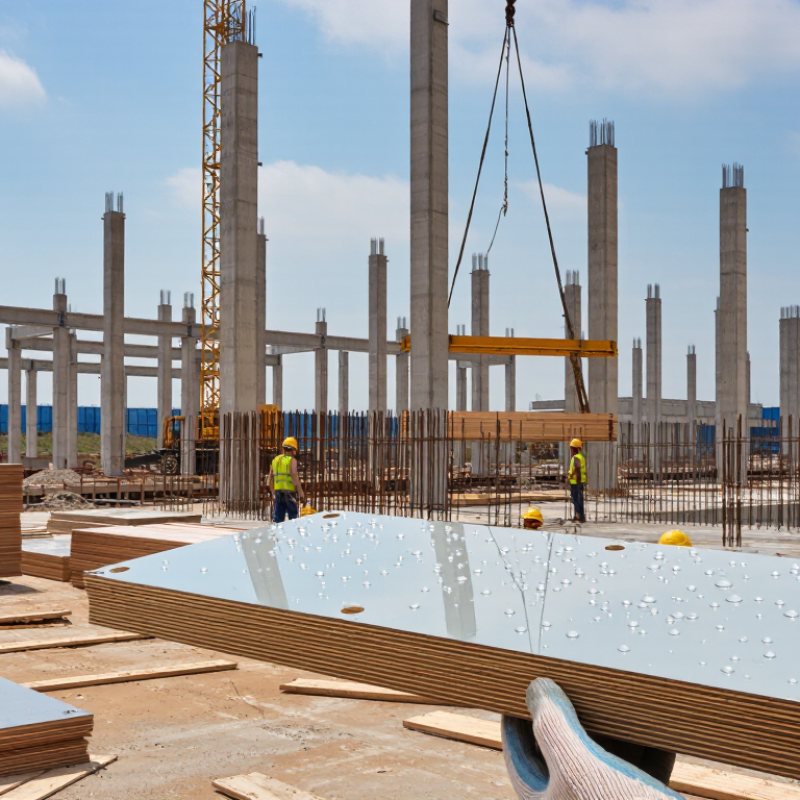
Define Formwork Loads and Spans for Standard 18–21 mm Panel Thicknesses
How to Choose Concrete Forming Plywood for Global Projects?
For 18–21 mm forming plywood, define loads before comparing surface quality or price. Fresh concrete usually weighs about 24 kN/m³. Add workers, tools, vibration, impact, and local safety factors. Wet concrete pressure also changes with pour rate, temperature, slump, and wall height. A slow wall pour may behave differently from a rapidly filled column form.
Then define the panel span between joists or walers. A wider span increases bending and visible deflection. Check both strength and serviceability, because a panel can remain unbroken yet leave waves on the concrete face. Panel direction matters. Place the stronger face-grain direction across the main supports when the construction is designed that way. Confirm this with tested data, not assumptions. Species, veneers, glue quality, moisture, and repeated use can change performance. An 18 mm panel may suit a short span, while a 21 mm panel may offer more stiffness, but thickness alone does not guarantee reliability.
Tips: Draw the support grid first. Calculate the tributary area for each panel. Compare calculated reactions with the plywood’s verified performance data. Keep edges supported, seal cut edges, and inspect swelling after each pour. I once underestimated vibration loads on a small wall form. The plywood survived, but the finish did not. That result deserved a second review. Use project-specific engineering checks and applicable local formwork standards before approval.
Select EN 636 and EN 314-2 Class 3 Panels for Wet Concrete Exposure
Choosing concrete forming plywood for an international project starts with moisture resistance, not appearance. Wet concrete can remain against the panel for hours or days. Rain, washing, and repeated stripping add further stress. EN 636-3 plywood is intended for exterior conditions, while EN 314-2 Class 3 confirms durable bonding for severe exposure. Together, these classifications provide a stronger basis for wet concrete work.
Check the panel markings and supporting test documents before purchase. Do not rely only on a sales description. Inspect the core for gaps, loose veneers, and uneven thickness. Sealed edges help limit water entry, especially around cutouts and bolt holes. A smooth, dense face can improve concrete finish and reduce cleaning time. Still, surface quality alone cannot prove structural reliability.
On site, store sheets flat and above standing water. Keep them covered, but allow ventilation. Apply a compatible release agent in a thin, even film. Too much oil may stain the concrete or weaken the panel surface. Panels should be checked after each pour for swelling, open edges, and damaged corners. A perfect-looking sheet can still hide internal defects. Conversely, a minor mark may not justify rejection. This is where project experience matters, although inspection decisions should follow the engineer’s requirements and local standards. International supply also needs clear documentation, because equivalent labels are not always equivalent performance.
Compare Phenolic Overlay Weights from 120 to 240 g/m² for Surface Finish
Selecting forming plywood for global projects starts with the overlay, not the catalogue photograph.
Phenolic overlay weight usually ranges from
120 to 240 g/m².
120 g/m² film can provide a clean finish for moderate reuse and controlled handling.
However, edges may show wear sooner on rough sites.
180 g/m² overlay offers a practical balance between appearance, stripping performance, and cost.
The
240 g/m² option creates a tougher working skin for repeated pours, abrasive contact, and demanding transport conditions.
The USDA Forest Products Laboratory’s Wood Handbook explains that moisture changes can cause wood-based panels to swell, shrink, and lose dimensional stability. That risk increases when plywood faces or edges remain unsealed. Therefore, project teams should check overlay adhesion, edge sealing, panel thickness, and moisture resistance together. ASTM D1037 provides widely used methods for evaluating wood-panel properties, while EN 636 classifies plywood for different service conditions. These references help, but they do not replace site trials.
In practice, I would test all three weights beside the actual concrete mix. Record surface pinholes, cement pickup, release effort, and panel deflection after several cycles. Small details matter. A heavier film is not automatically better. Excessive stiffness can complicate cutting, and a premium surface may still fail after careless edge treatment. Some project specifications also overstate expected reuse. That assumption deserves challenge. Temperature, vibration, storage, and cleaning methods often control service life more than overlay weight alone. A documented trial on local materials remains the most reliable decision tool.
Verify 6–14% Moisture Content, Tolerances, and ASTM D3043 Strength Data
How to Choose Concrete Forming Plywood for Global Projects?
Concrete forming plywood must survive moisture, pressure, handling, and repeated stripping. A practical inspection begins with moisture content. For many project specifications, acceptable plywood moisture falls between 6% and 14%. Confirm the required range before shipment. Measure several sheets, not just one.
Use a calibrated moisture meter and record readings from different stacks. Check the panel core, edges, and face separately. Wood near an open container may dry faster. Covered storage can hide internal moisture. Allow panels to acclimatize when site conditions differ greatly. Measure twice. Small errors compound.
Dimensional tolerances also deserve attention. Verify thickness, length, width, squareness, and edge condition against the project specification. A thin panel can change form alignment under pressure. A bowed sheet may leave visible concrete marks. ASTM D3043 strength data can support engineering review, but numbers need context. Check the test procedure, panel direction, span, conditioning, sample size, and reported failure values. Average strength alone may conceal weak results.
Ask for traceable inspection records, not isolated laboratory figures. Compare production batches when projects cross borders. Local humidity, transport time, and storage practices can change performance. I have seen teams trust a supplier’s general table too quickly. That shortcut feels efficient, but it weakens risk control. Recheck critical sheets after arrival. A clean document is useful, yet the plywood still needs physical verification.
Calculate Global Cost by Reuse Cycles, Shipping Weight, and 40-Foot Container Capacity
How to Choose Concrete Forming Plywood for Global Projects?
Global plywood selection should begin with cost per usable pour, not sheet price. Calculate it with this simple model: purchase cost, inland handling, ocean freight, and import-related charges, divided by realistic reuse cycles. A sheet costing more may perform better after twelve pours. A cheaper sheet may fail after three. Site conditions change everything. Moisture, release agents, cutting, and storage can reduce expected cycles. Use field records whenever possible.
Shipping weight also affects the real budget. Multiply sheet count by each sheet’s weight, then add pallets, protection, and packaging. A 40-foot container may hold about 67 cubic meters, but payload limits often matter more than volume. Dense panels can reach the weight limit before the space is full. Compare both calculations. Ask your logistics team to confirm container dimensions, loading patterns, and regional weight restrictions.
Tips: Build three scenarios: conservative, expected, and optimistic. Use lower reuse cycles for inexperienced crews. Check whether damaged sheets can be repaired or only discarded. Small errors accumulate.
Do not rely on a supplier’s maximum reuse claim without trial panels. A controlled site test can measure edge swelling, surface transfer, and cleaning time. These details influence labor cost. One overlooked issue is empty container space; poor stacking can raise freight cost per sheet. My calculation would still include a contingency, because weather delays and handling damage are difficult to predict. The cheapest spreadsheet result is not always the safest project choice.
How to Choose Concrete Forming Plywood for Global Projects? - Calculate Global Cost by Reuse Cycles, Shipping Weight, and 40-Foot Container Capacity
| Plywood Type | Panel Size (mm) |
Thickness (mm) |
Density (kg/m³) |
Weight per Panel (kg) |
Expected Reuse Cycles |
Indicative Panel Price (USD) |
Panels per 40-Foot Container |
Container Payload (kg) |
Ocean Freight Allocation (USD/Panel) |
Landed Cost per Use (USD/Cycle) |
|---|---|---|---|---|---|---|---|---|---|---|
| Standard film-faced plywood | 1220 × 2440 | 18 | 620 | 33.2 | 6 | $30.00 | 783 | 25,986 | $2.81 | $5.47 |
| High-density film-faced plywood | 1220 × 2440 | 18 | 680 | 36.4 | 10 | $42.00 | 714 | 25,989 | $3.08 | $4.51 |
| Heavy-duty phenolic plywood | 1220 × 2440 | 18 | 720 | 38.5 | 16 | $55.00 | 674 | 25,981 | $3.26 | $3.64 |
| Premium high-reuse plywood | 1220 × 2440 | 18 | 760 | 40.7 | 25 | $68.00 | 638 | 25,984 | $3.45 | $2.86 |
FAQS
Choose panels rated for exterior conditions and severe moisture exposure. These classifications support durable bonding during wet concrete work. They do not guarantee perfect performance. Check markings and test documents before purchase.
Inspect the core for gaps, loose veneers, and uneven thickness. Check sealed edges, cutouts, and bolt holes carefully. A smooth face can improve concrete finish. Appearance alone proves little.
A lighter overlay may suit moderate reuse and careful handling. A medium-weight overlay often balances finish, stripping, and cost. A heavier overlay can resist abrasion and transport damage. Heavier is not automatically better.
Test different overlay weights with the actual concrete mix. Record pinholes, cement pickup, stripping effort, and deflection. Run several cycles. One successful pour is weak evidence.
Many specifications use a moisture range of 6% to 14%. Confirm the project requirement before shipment. Measure several sheets from different stacks. Measure twice.
Use a calibrated moisture meter and record each reading. Check the face, edge, and core separately. Covered storage may hide internal moisture. Let panels acclimatize when site conditions differ greatly.
Verify thickness, length, width, squareness, and edge condition. A bowed sheet may leave marks on the concrete. A thin panel can affect form alignment. Small errors compound.
Store sheets flat and above standing water. Keep them covered, but allow ventilation. Protect corners from impact. Damp storage can quietly reduce service life.
Apply a compatible release agent in a thin, even film. Too much oil may stain the concrete. It may also weaken the panel surface. More coating is not always safer.
Request traceable inspection records and supporting test data. Check the test method, sample size, conditioning, and failure values. Compare production batches when possible. A clean document still needs physical verification.
Conclusion
Choosing Concrete Forming Plywood for global projects requires balancing structural performance, durability, surface quality, and total logistics cost. Begin by defining the expected formwork loads, support spacing, and panel spans so the appropriate 18–21 mm thickness can be selected. For repeated exposure to wet concrete, specify panels meeting EN 636 and EN 314-2 Class 3 requirements, then compare phenolic overlay weights from 120 to 240 g/m² according to the desired concrete finish and expected reuse cycles.
Before shipment, verify moisture content within 6–14%, dimensional tolerances, edge quality, and structural strength data supported by ASTM D3043 testing. A reliable evaluation should also consider the number of usable cycles rather than purchase price alone. Calculate the global delivered cost by including panel weight, shipping charges, and the quantity that can be loaded into a 40-foot container. This integrated approach helps project teams select panels that provide consistent performance, efficient handling, and predictable value across different climates and construction conditions.

Blog Tags: